
Report-Builder: Market Overview
We are excited to announce we're adding report-builder functionality to Signal, beginning with Market Overview aimed at answering questions like:
- Which states have the highest and lowest reimbursement profile for my services of interest?
- Within those states, what are the various payers offering for reimbursement at the high-end, median, and low-end?
- Which payer partnerships should we pursue and what economics should we expect?
Entering report mode
Now, when you enter Signal, you will see 2 modes for engaging with the price transparency data:
- "Explore" mode in green is the classic configuration to pull data across payer-posted and/or hospital-posted files
- "Compare" mode allows you to do comparisons across markets and providers
- Market Overview is the report configuration we'll be covering today
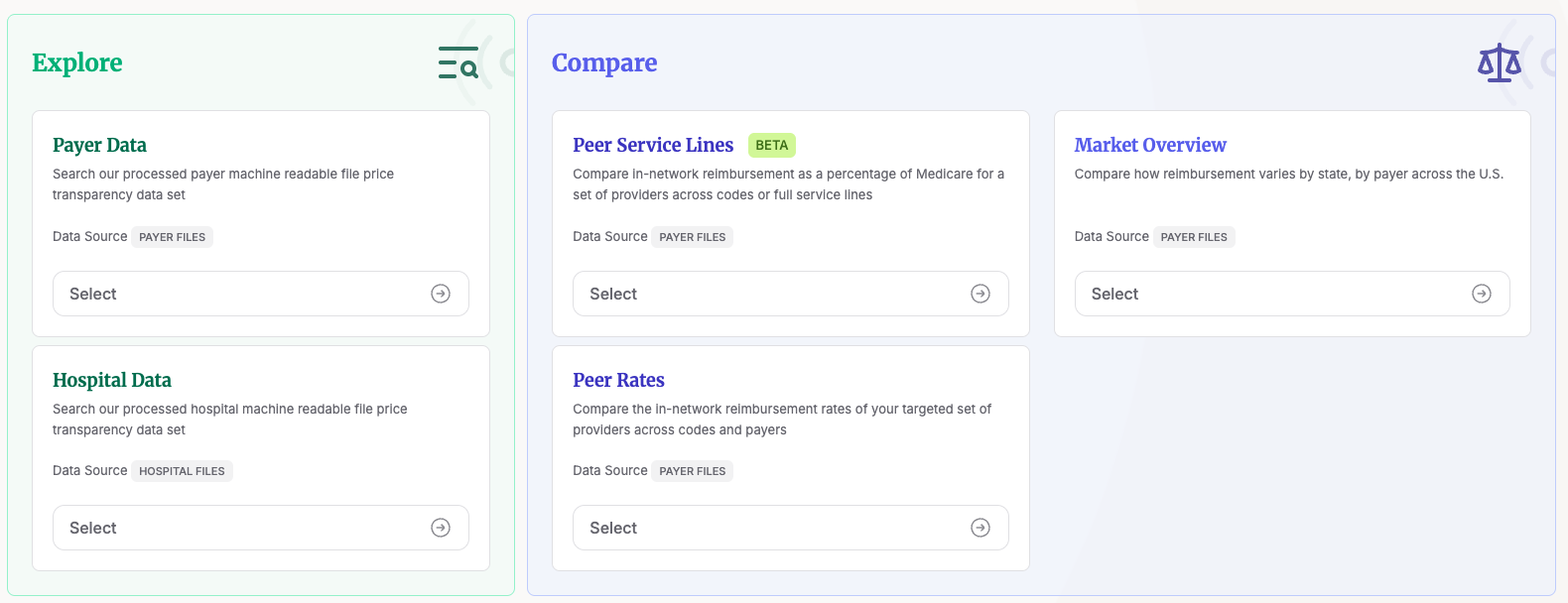
Let's click on 'Market Overview' to get started .
Building, exporting, and exploring market overview reports
Once you enter the market overview report mode, you will see the same set of panels you are familiar with for explore mode — but with the following key differences:
- The providers panel has been disabled — if you would like to search up specific providers' rates, we recommend going to explore mode and looking at resources like our provider search guide or provider search FAQs
- Compared to explore mode where you have to specify both a payer and a code-set, all you need to generate a market overview report is just 1 code
So, let's select a code — 99213 — and build a report:
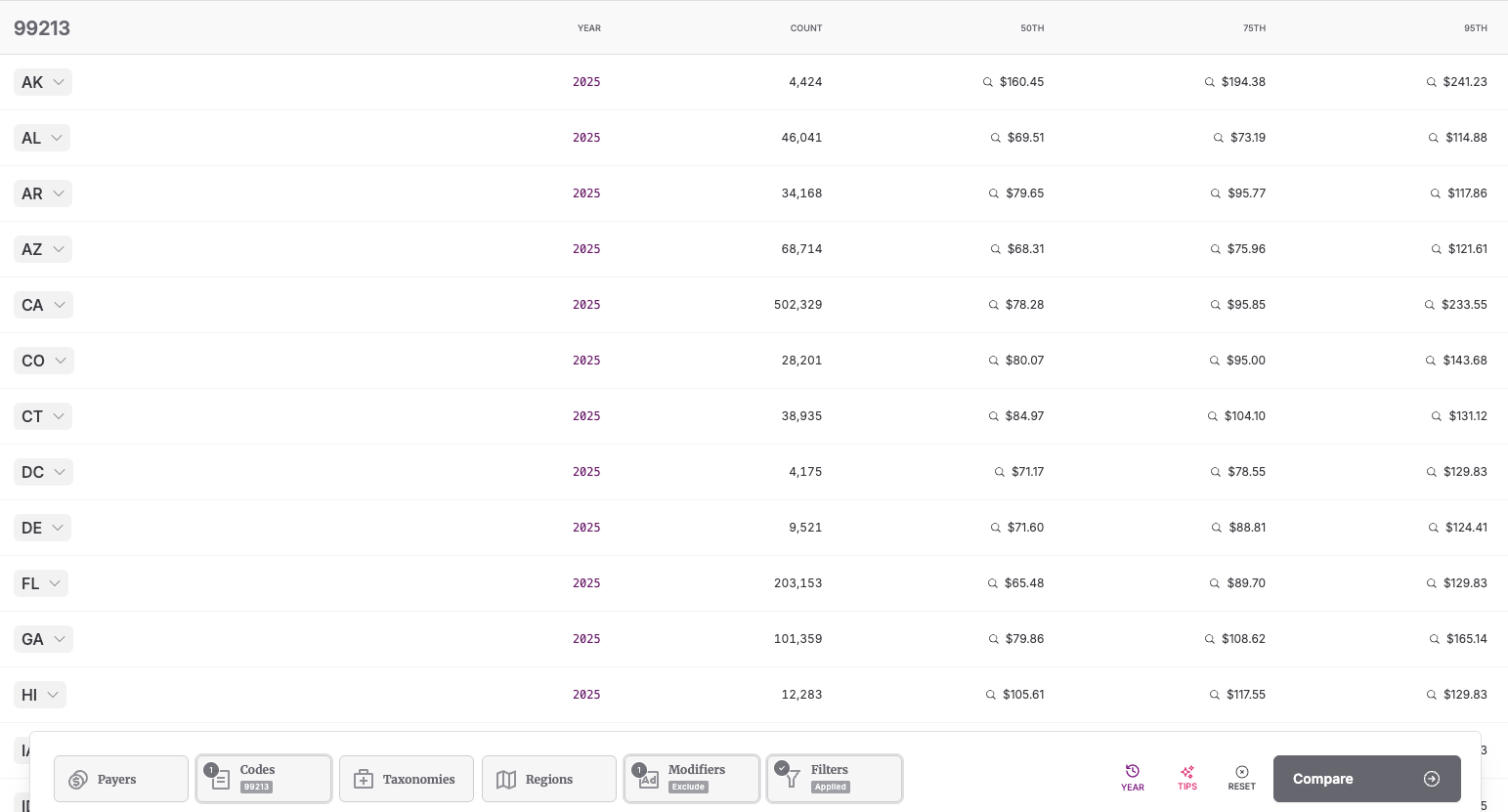
As shown above, the standard output is a grouped table by state showing a percentile distribution for each code selected — from this view:
- You can expand a state to see what specific payers' reimbursement profiles look like:
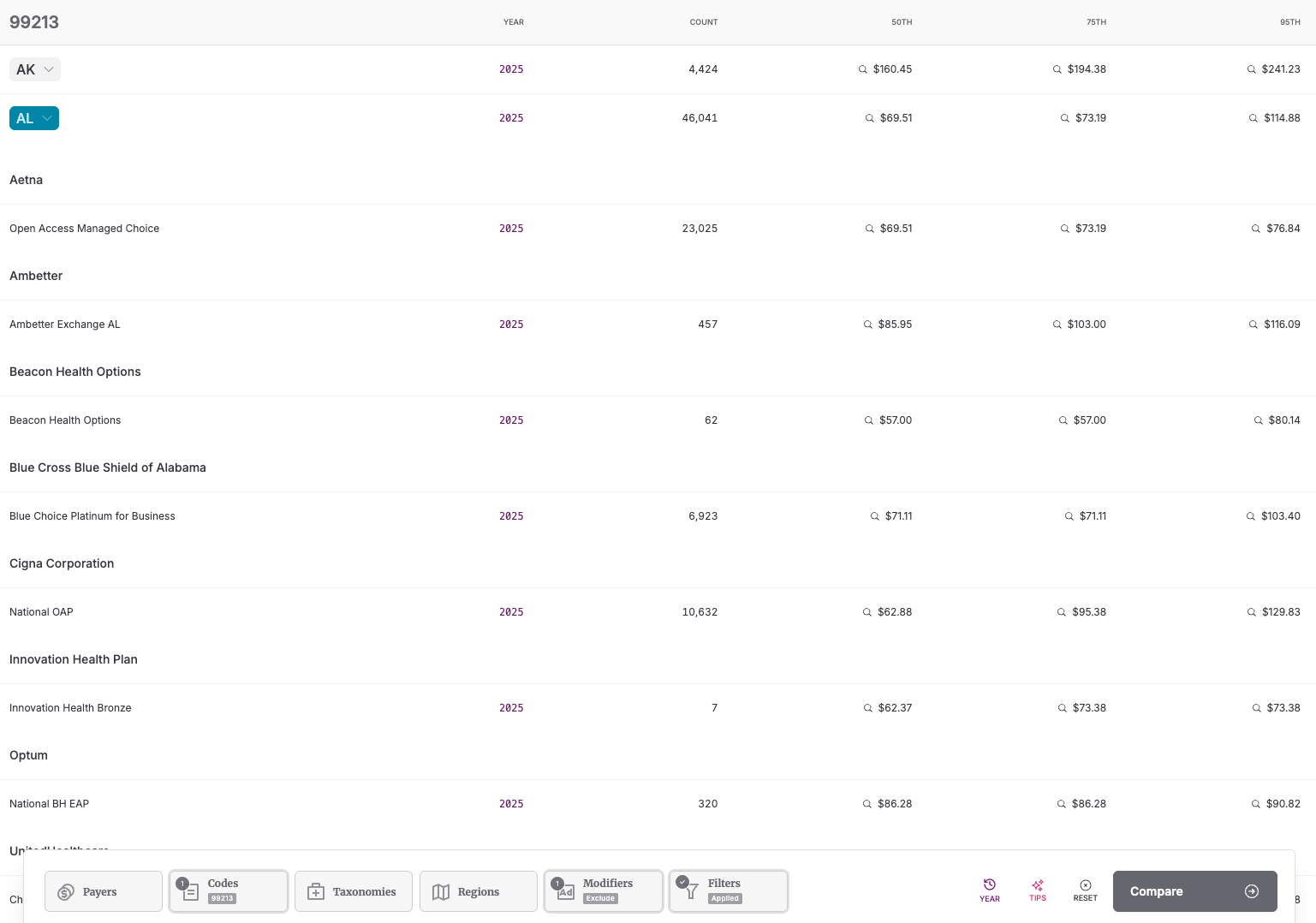
- Using the bottom tool-bar, you can export all of the data across all 50 states + DC (including the specific break-downs by payer in each region) to .csv for further analysis

- Lastly, you can click any number you see on the market overview report and see which providers have those rates contracted in search mode

If you need to edit or further narrow down your distribution, the filters you are familiar with in search mode are available for use:
- Payers: you can always select down the health plans you want to analyze (e.g., to just United, Cigna, Aetna) for example
- Taxonomies: to refine your comparison, you can multi-select from various NUCC specialties using this panel (e.g., for ear-nose-throat doctors, search just otolaryngology physicians)
- Regions: you can also down-select a specific set of states if nation-wide analysis is not necessary, you can also select a specific CBSA
- Modifiers: by default, we exclude these to ensure apples-to-apples comparison against global rates in listed distributions but if you would like to look at specific modifiers (e.g., 'TC' for the technical component of radiology procedures) you can
- Other filters:
- Arrangement: Defaulted to fee-for-service to again ensure valid, like-for-like comparison across distributions
- Negotiation Type: Percentage of billed charges arrangements excluded to ensure all rates are comparable dollar amounts
- Billing Class: Professional selected by default to avoid mixing pro fees with facility or institutional fees
- Is Billable: False excluded to avoid noise from 'junk rates' — more detail here: https://help.serifhealth.com/article/6-how-does-the-price-transparency-data-differ-from-claims-data
- Hide Outliers: On by default to filter out 'noise' from placeholder rates (e.g., $99,999.99 for a 30 minute office visit)
We hope this report is useful and would love to hear feedback on any enhancements or suggestions to further improve the platform. If you have any questions or ideas, feel free to reach out to support@serifhealth.com